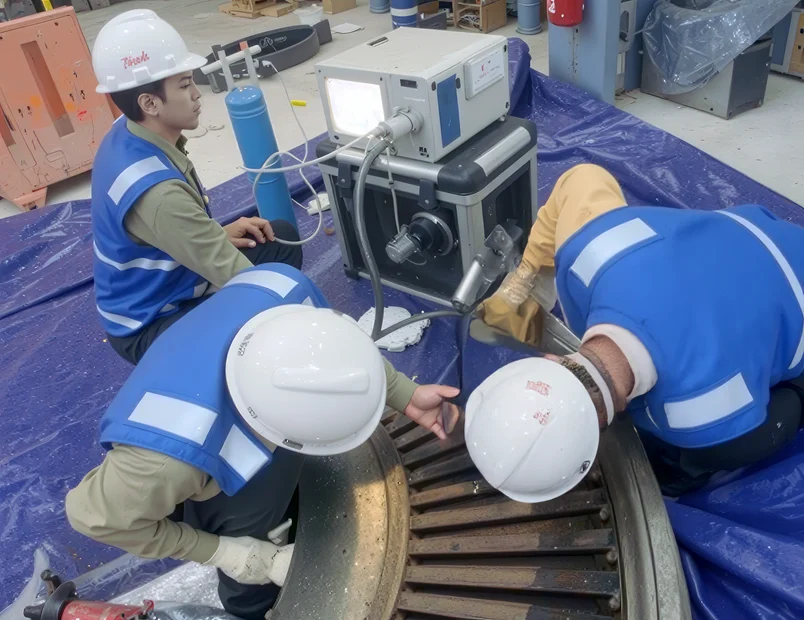
PLTP Gunung Salak — Turbine Blade Material Inspection
PLTP Gunung Salak — Comprehensive Material Characterization
Comprehensive material characterization and reverse engineering study to support the development of non-OEM geothermal steam turbine blade spare parts with equivalent or improved performance.
Geothermal steam turbine blades operate under high-temperature, corrosive, and erosive environments, making material integrity critical to long-term plant reliability.
This project focused on material testing, data validation, and reverse engineering of existing geothermal steam turbine blades at PLTP Gunung Salak. The objective was to establish a reliable technical material database that can be used as a foundation for future local manufacturing of alternative spare parts, reducing dependency on OEM supply chains.
Most steam turbine blade spare parts are supplied exclusively by OEMs, creating several operational challenges:
Long procurement lead times for replacement parts.
High component costs from exclusive suppliers.
Limited access to detailed material specifications.
Risk of extended outages during maintenance.
To mitigate these risks, the client required verified material data and engineering-backed recommendations to support reverse engineering.
Onsite material data acquisition using PMI/Spectro testing and portable hardness testers.
Detailed chemical composition analysis and hardness testing of rotor blades and diaphragms.
Measurement of coating thickness and assessment of wear patterns across turbine stages.
Comparative analysis against ASTM standards and technical reporting with recommendations.
Verified Composition: Chemical composition generally aligned with ASTM standards.
Suitable References: Existing materials confirmed technically suitable as reference for reverse engineering.
Optimized Manufacturing: Recommendations provided for coating specification and quality assurance.
Strong Foundation: Findings provide a strong technical foundation for local fabrication intitiatives.
Material data can be reliably used for alternative non-OEM spare part development, enabling greater independence and cost efficiency.
Visual documentation of the material testing, inspection, and analysis process.
Garuda Engineering delivers high-confidence reverse engineering solutions.
"We bridge laboratory data, field reality, and engineering judgment into actionable recommendations."
Ensure the quality and reliability of your non-OEM parts. Contact Garuda Engineering for comprehensive material testing and reverse engineering support.